
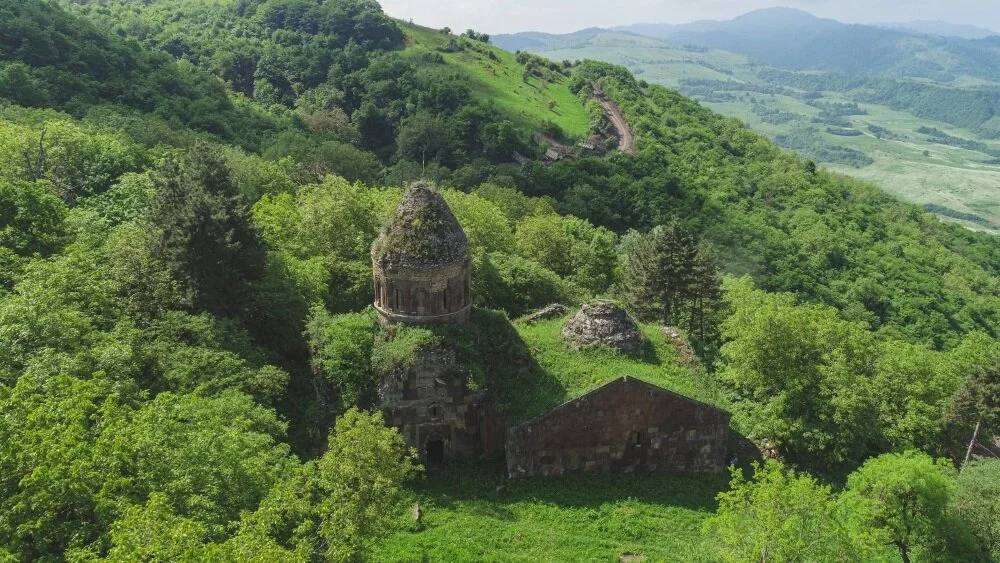
Located in the village of Chinari in the Tavush region of Armenia, Khoranashat Monastery arm. (“khoran” – altar, “shat” – many) was established in the first part of the 13th century by Vanakan Vardapet with the help of the Vagramyan rulers. Encircled by crumbling fortress walls, the complex consists of two cemeteries, a chapel, cells, and the churches of Surb Astvatsatsin (Holy Mother of God) and Surb Kiraki (Holy Resurrection).
Grigor Narekatsi’s “Book of Lamentations” is one of the priceless manuscripts produced in Khoranashat, a significant writing center. A unique copy of this Gospel can be found at Halle, Germany, and several of them are preserved in the Matenadaran.
Constructed between 1211 and 1222, the main church Surb Astvatsatsin stands out for its unique altar shape, which features fourteen niches. The church’s narthex (1222–1240) features a distinctive roof with a star with six wings. To the south, the 13th-century Surb Kiraki church is situated.
Known academics and thinkers like Vardan Areveltsi and Grigor Aknerci taught in Khoranashat, a significant educational and cultural hub in medieval Armenia. Following the Tatar-Mongol invasion in 1225, Kirakos Gandzaketsi, an Armenian historian, abandoned the monastery.